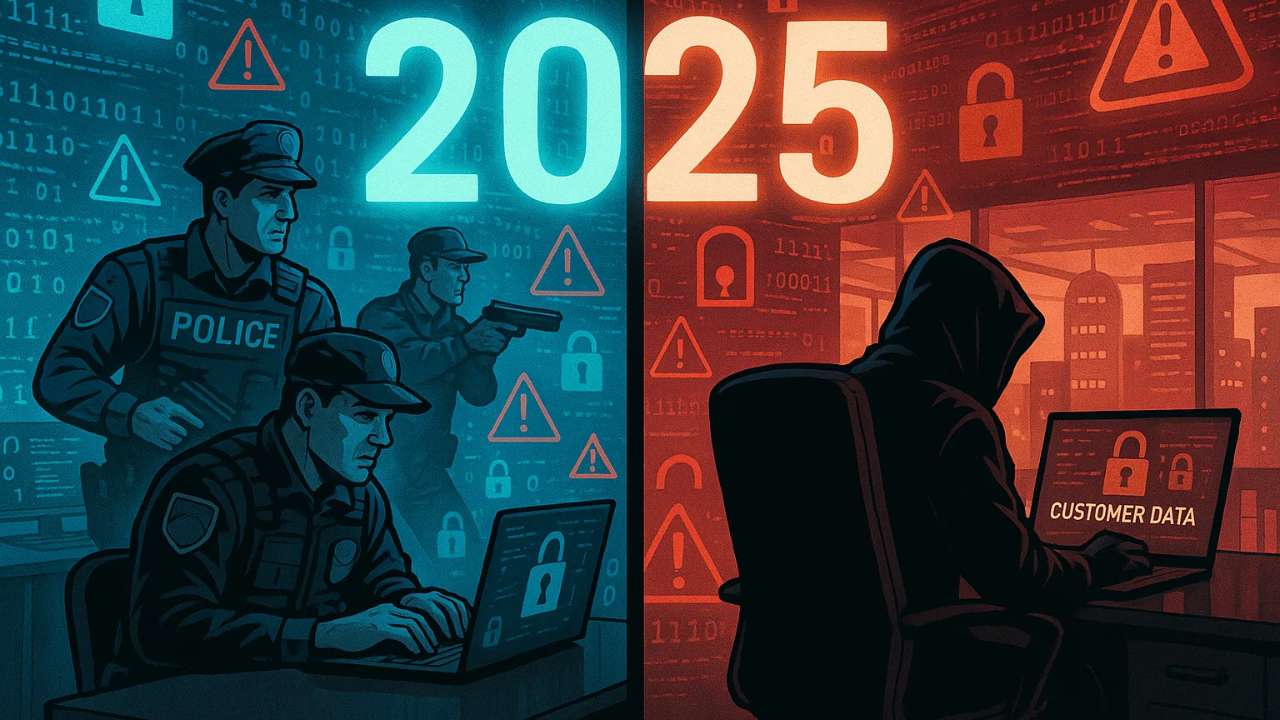
Picture this: while international law enforcement just scored their biggest cybercrime takedown ever, one of America’s largest crypto exchanges got blindsided by its own support staff. Welcome to cybersecurity 2025, where the good guys are winning battles but the war just got way more complicated.
The cybersecurity landscape in 2025 isn’t just about fancy malware anymore. It’s a high-stakes chess match where billion-dollar operations can crumble from a $50 bribe to an overseas customer service rep. I’ve been covering tech security for years, but what happened between Operation Endgame’s triumph and Coinbase’s spectacular failure tells us everything about where digital threats are heading.
Operation Endgame Delivers Knockout Punch to Global Cybercrime
Let me paint you the picture of what just went down. Operation Endgame isn’t your typical law enforcement raid. This is the cybersecurity equivalent of the Avengers assembling, with Europol leading a coalition that includes the FBI, German federal police, and agencies from the Netherlands, France, and the UK.
Between May 19-22, 2025, they executed what I can only describe as digital warfare. The numbers are staggering: 300 servers taken down globally, 650 malicious domains neutralized, and international arrest warrants issued for 20 key suspects. They even seized over €21.2 million in cryptocurrency, which tells you just how profitable these criminal operations had become.
But here’s what makes this operation brilliant. Instead of playing whack-a-mole with random hackers, they went straight for the throat of the cybercrime economy by targeting Initial Access Brokers. Think of these guys as the locksmiths of cybercrime. They break into networks and then sell that access to ransomware gangs, who come in later to deploy the devastating attacks we hear about on the news.
The malware they dismantled reads like a who’s who of digital destruction. Bumblebee, Qakbot, Trickbot, and DanaBot aren’t just random names – these are the Swiss Army knives of cybercrime. Each one serves as a delivery mechanism for ransomware, capable of stealing banking credentials, capturing keystrokes, and giving criminals remote access to entire networks.
What really impressed me was how they handled the cat-and-mouse game. Many of these malware families had already been disrupted in 2024, only to pop back up with new variants. The criminals thought they were clever, rebranding and retooling their operations. Operation Endgame’s response? “Season 2.” They came back harder, smarter, and more coordinated than before.
Coinbase Breach Reveals the $400 Million Human Factor Problem
Now, while law enforcement was celebrating their technical victories, Coinbase was dealing with something far more insidious. In May 2025, the crypto giant disclosed that 69,461 customers had their data stolen. The kicker? It wasn’t some sophisticated zero-day exploit or advanced persistent threat. It was good old-fashioned corruption.
Attackers bribed “a small number of individuals” working at Coinbase’s overseas retail support locations, reportedly in India. These insiders used their legitimate access to customer support tools to steal everything from Social Security numbers to government ID photos. The breach lasted for months, with some security researchers claiming they’d been warning Coinbase about suspicious activities since early 2024.
The timeline controversy really gets my blood boiling. Coinbase claims they discovered the breach on May 11, 2025, the same day attackers demanded $20 million ransom. But their own SEC filing admits they detected “improper data access” in “previous months.” Security researchers like Taylor Monahan from MetaMask were practically screaming warnings about insider threats and user losses for over six months.
Here’s what makes this breach particularly terrifying: the stolen data included home addresses paired with account balances. We’re not just talking about credit card fraud here. Crypto security expert Michael Arrington warned this information could enable physical attacks, including targeted robberies or kidnappings of high-value cryptocurrency holders. The digital threat just became very real-world dangerous.
Coinbase’s response has been mixed. They refused the ransom demand and offered a $20 million bounty for information leading to arrests. They’re also reimbursing customers who got scammed as a direct result of this breach, with estimated costs between $180-$400 million. That’s not just a security failure – that’s a business-threatening event.
Why Technical Wins Can’t Stop Human Vulnerabilities
Here’s the harsh reality that 2025 has taught us: you can dismantle every botnet on the planet, but you still can’t patch human nature. Operation Endgame represents the pinnacle of technical cybersecurity enforcement, while the Coinbase breach shows us that sometimes the biggest threats come from within.
The malware that Operation Endgame targeted requires sophisticated technical knowledge to deploy and maintain. These aren’t script kiddies we’re talking about – they’re professional cybercriminals running operations worth millions. But the Coinbase attackers? They just needed to identify which support agents were struggling financially and willing to take a bribe.
This creates a fascinating dichotomy in cybersecurity 2025. On one hand, we have international law enforcement agencies conducting military-precision operations against technical threats. On the other hand, we have billion-dollar companies getting outsmarted by simple social engineering and bribery schemes.
The convergence of these threats is what really worries me. The technical capabilities demonstrated by the malware families in Operation Endgame, combined with the insider access shown in the Coinbase breach, could create devastating hybrid attacks. Imagine if the same criminal organizations that operated Qakbot or DanaBot started systematically recruiting insiders at major financial institutions.
The AI Revolution in Cybersecurity Threatens Everything
Looking ahead, cybersecurity 2025 is just the beginning of something much bigger. Artificial intelligence is about to supercharge both sides of this digital arms race in ways we’re only starting to understand.
The criminals are already adapting. Google recently reported government-backed actors using generative AI for vulnerability research and malware development. But the real game-changer will be AI-powered social engineering. Think deepfake voice technology combined with stolen personal data to create real-time impersonations that can bypass voice verification systems.
The democratization of AI tools is lowering the barrier to entry for cybercrime. You no longer need to be a coding genius to launch sophisticated attacks. Soon, recruiting and managing insider threats could become as systematized as the Malware-as-a-Service model we see today.
For the defenders, AI offers hope for detecting anomalous behavior and predicting attack patterns. But it also creates new vulnerabilities. Every AI system trained on sensitive data becomes a potential target. Every automated decision creates a new attack surface.
Building Cybersecurity Defense for the New Reality
The lessons from Operation Endgame and the Coinbase breach aren’t just cautionary tales – they’re a roadmap for building better defenses. Here’s what organizations need to understand about cybersecurity 2025.
First, technical security alone is insufficient. You need comprehensive insider threat programs that go beyond background checks. Continuous monitoring of privileged access, behavioral analytics, and psychological support for employees facing financial stress are becoming mandatory, not optional.
Second, transparency isn’t just good PR – it’s essential for effective defense. The controversy around Coinbase’s disclosure timeline damaged trust with security researchers who were trying to help. Companies that hide security incidents lose access to the broader security community’s intelligence and expertise.
Third, international cooperation works. Operation Endgame succeeded because agencies shared intelligence, coordinated operations, and maintained persistence across years. The private sector needs similar cooperation models to share threat intelligence and coordinate responses to sophisticated attacks.
The zero-trust security model becomes more critical than ever. Assume every user, device, and connection is potentially compromised. Implement least-privilege access controls, continuous authentication, and data-centric security that protects information regardless of where it lives or who accesses it.
What This Means for Your Digital Security
For individuals, cybersecurity 2025 demands new levels of vigilance. The combination of stolen personal data and AI-powered social engineering means traditional security advice isn’t enough anymore. Verify every unexpected contact through independent channels, even if they know your personal information. Enable multi-factor authentication everywhere, and consider the physical security implications of your digital footprint.
For businesses, the stakes have never been higher. The operational security lessons from both Operation Endgame and the Coinbase breach are clear: diversify your security investments across technical, human, and procedural controls. Don’t assume your overseas contractors are secure just because they’re cheaper. Don’t assume your technical defenses will stop a determined insider.
The cryptocurrency industry faces particular challenges. These platforms hold direct access to valuable digital assets while serving customers who often prefer anonymity. Balancing regulatory compliance, security, and user privacy requires sophisticated approaches to data minimization and zero-trust architectures.
The Never-Ending Cybersecurity Arms Race
What strikes me most about cybersecurity 2025 is how it perfectly illustrates the adaptive nature of this conflict. Law enforcement scores massive technical victories, and criminals pivot to human vulnerabilities. Companies implement advanced technical controls, and attackers find ways to corrupt insiders. It’s a never-ending cycle that demands constant innovation from defenders.
The framing of Operation Endgame as multiple “seasons” acknowledges this reality. Cybercrime isn’t a problem to be solved once and forgotten. It’s an ongoing conflict that requires sustained resources, international cooperation, and continuous adaptation. The fact that malware families like Qakbot keep reappearing years after initial takedowns proves how resilient these criminal ecosystems have become.
Looking forward, success in cybersecurity will require balancing multiple approaches simultaneously. Technical measures like those demonstrated in Operation Endgame must be paired with human-focused security programs that address the vulnerabilities exposed in the Coinbase breach. Traditional perimeter security must evolve to zero-trust models that assume compromise. Reactive incident response must be supplemented with proactive threat hunting and intelligence sharing.
The cybersecurity landscape of 2025 has taught us that our digital future depends not just on building better technical defenses, but on understanding and addressing the human elements that make those defenses possible. As artificial intelligence amplifies both attack and defense capabilities, the organizations that survive and thrive will be those that invest equally in technology, people, and processes.
The battle for cybersecurity 2025 is far from over. But the lessons from Operation Endgame’s successes and Coinbase’s failures provide a roadmap for building more resilient defenses in an increasingly dangerous digital world. The question isn’t whether you’ll face these threats – it’s whether you’ll be ready when they arrive.
Also Read: Oracle Drops $40B on Nvidia Chips in Massive AI Power Play